Our Location
No. 66, Tongda Road, Economic Development Zone, Tengzhou City, Shandong Province, China
No. 66, Tongda Road, Economic Development Zone, Tengzhou City, Shandong Province, China
Precision, repeatability, and absolute traceability are non-negotiable in aerospace manufacturing. Advanced press systems must be engineered to meet stringent AS9100 standards, shaping complex superalloys and aerospace-grade components with flawless accuracy.
Aerospace component manufacturing requires specialized forming methodologies and specific press architectures to overcome the limitations of traditional cold stamping.
Shaping high-strength titanium alloys and nickel-based superalloys requires heating materials to near-melting points to achieve complex geometries without cracking or spring-back.
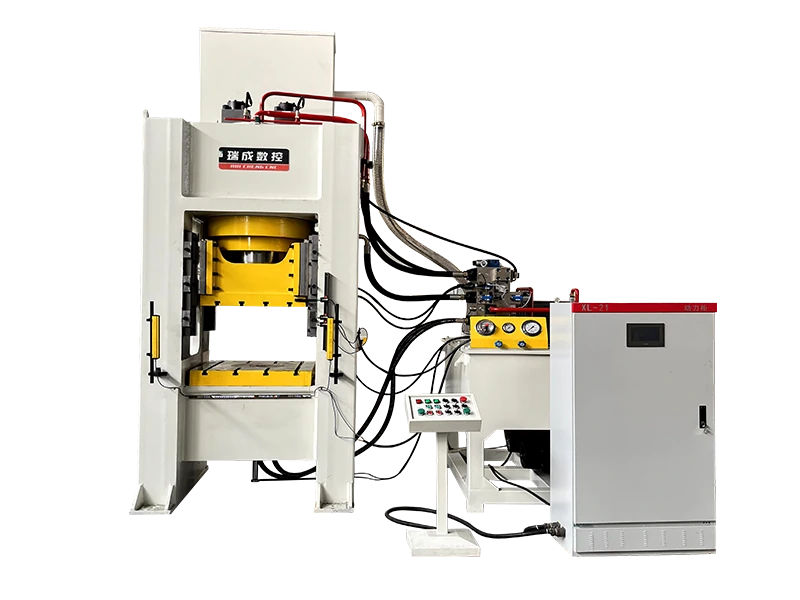
Equipment Requirement: For high-precision SPF tooling where off-center loading is severe due to asymmetric heating, H-frame (straight-side) presses are frequently specified. Their massive, pre-stressed frames maintain strict parallelism and resist deflection under extreme thermal gradients.
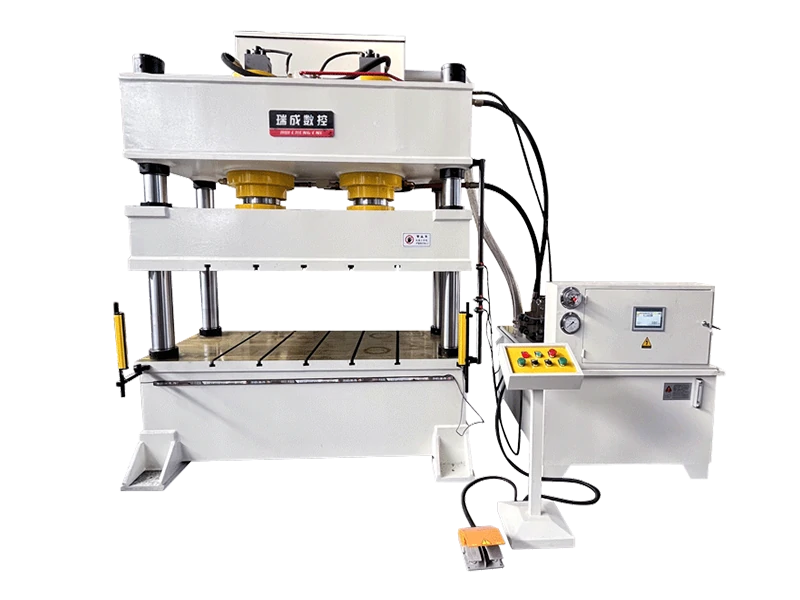
Sheet hydroforming and elastoforming processes utilize high-pressure fluid or rubber bladders to form aerodynamic components like fuselage panels and wing skins.
Equipment Requirement: To accommodate the large rubber bladders or fluid cells required for these expansive parts, four-column hydraulic presses are the industry standard. They offer expansive bolsters and unobstructed three-sided access, allowing for easy integration of automated part handling and rubber pad installation.
Standard industrial presses cannot meet the rigorous demands of flight-critical component manufacturing. Specialized architectural features are mandatory.
Provides full programmable control over speed, ram position, and force at any point in the stroke. Eliminates hydraulic fluid risks, reduces maintenance by up to 80%, and ensures absolute repeatability for compression molding and hot forming.
Utilizes high-speed motion controllers and linear transducers to dynamically synchronize actuators. This maintains precise bed-to-ram parallelism despite severe off-center loading or thermal expansion of the tooling during cure cycles.
Advanced PLC systems record pressure, displacement, temperature, and time at millisecond intervals. This data is essential for AS9100 compliance, allowing every flight-critical part to be traced back to its exact production parameters.
Forming is only half the equation. Press systems must also facilitate or simulate the extreme conditions components will face in flight and space.
Evaluates the ultimate structural integrity of wings, fuselages, and landing gear under maximum design loads.
Subjects components to millions of repeated stress cycles to predict long-term durability and prevent in-flight failures.
Simulates extreme transient events, such as bird strikes or runway debris impact, to validate material toughness.
Assesses component performance under combined extreme temperatures, high humidity, and high-frequency vibrations.
Submit your material specifications, geometric requirements, and production volume. Our engineering team will outline the optimal press architecture, whether it requires H-frame rigidity for SPF, four-column openness for hydroforming, or specialized configurations for oversized structures.
Get Quote on WhatsAppSPF requires sustained high temperatures and often involves asymmetric tooling that creates severe off-center loads. H-frame (straight-side) presses provide superior resistance to deflection compared to traditional designs, maintaining strict parallelism to ensure uniform wall thickness in titanium parts.
For oversized components like radar domes or large composite panels, gantry hydraulic presses provide customizable, ultra-wide bed capacities without the height restrictions of standard frames. For post-forming secondary operations such as precision trimming, piercing, and assembly, C-frame presses are utilized due to their compact footprint and three-sided open access.
Modern aerospace presses integrate advanced data acquisition systems that log every parameter of the forming cycle (tonnage, ram position, temperature, dwell time) to a centralized database. This creates an immutable digital record for every individual part, satisfying strict AS9100 and NADCAP audit requirements.
Heavy-duty gib-guided rams combined with Active Leveling Control (ALC) are essential. ALC uses real-time feedback from linear transducers to electronically synchronize the press actuators, dynamically compensating for asymmetric material flow and maintaining strict parallelism.